
HIDI at 40: Four Decades of Data, Trust and Innovation
Staff Contact: Brian Waterman
In its earliest days, the Hospital Industry Data Institute, established by the Missouri Hospital Association in 1985, looked a lot different than it does now.
Hospitals initially sent paper discharge records to HIDI, and HIDI staff manually entered those records, according to Brian Waterman, HIDI’s division vice president of product strategy and development.
“HIDI staff recognized early on, that based on member requests, we could produce a report that describes hospital-based utilization across the state. That report was made available to MHA members as a book,” said Waterman, who talked about HIDI’s 40th anniversary on a recent episode of MHA’s podcast, PolicyHuddle.
With technology evolving, the paper reports were replaced by interactive reports via CD-ROMs sent to member hospitals.
Today, the organization manages a cloud-based analytics infrastructure that supports real-time reporting, predictive modeling and complex program evaluation.
HIDI was an early adopter of web-based analytics, launching its first interactive reporting platform, HIDI Advantage Analytics, in the early 2000s.
That digital transformation yielded remarkable results. While it used to take three to five months to turn around insights for hospitals, HIDI adopted technology that dramatically reduced the time it takes to generate insights from raw data.
HIDI helps hospitals make faster, more informed decisions — from improving care quality to understanding health disparities to preparing for regulatory change.
More than just data collection
HIDI was initially founded to fulfill a core federal requirement that funneled down to the state level around health departments needing a comprehensive look at what was happening at hospitals, Waterman said.
Forward-thinking leaders at MHA and HIDI saw they could not only provide this data to meet these requirements, but also that the data could be utilized in other ways.
The tools HIDI developed led to less emphasis on the work required to make the descriptive data available and more emphasis on generating insights out of the data, Waterman said.
Hospitals today rely on HIDI to explore trends in mortality, complications and utilization. Increasingly, HIDI tools also are being used to forecast the future — modeling the impact of quality improvements, service line changes or shifting patient demographics.
When hospital leaders are looking at various process improvements or changes to their market or service area in some way, shape or form, “these insights become a super valuable addition to the types of business questions that a hospital executive might have or that a person taking care of people might have,” Waterman said.
“The value of being able to provide unbiased analytic insights driven by questions that are important to our entire membership is important,” he said.
One breakthrough has been the Master Patient Index, which allows HIDI to link patient encounters across hospitals. This enables more comprehensive evaluations of hospital programs and deeper understanding of community health dynamics.
“The Master Patient Index allows us to look at different kinds of business questions that previously we were unable to easily answer, like ‘Is this program that I'm investing in to improve quality or have an impact on my community resulting in a change in hospital-based utilization?’” Waterman said.
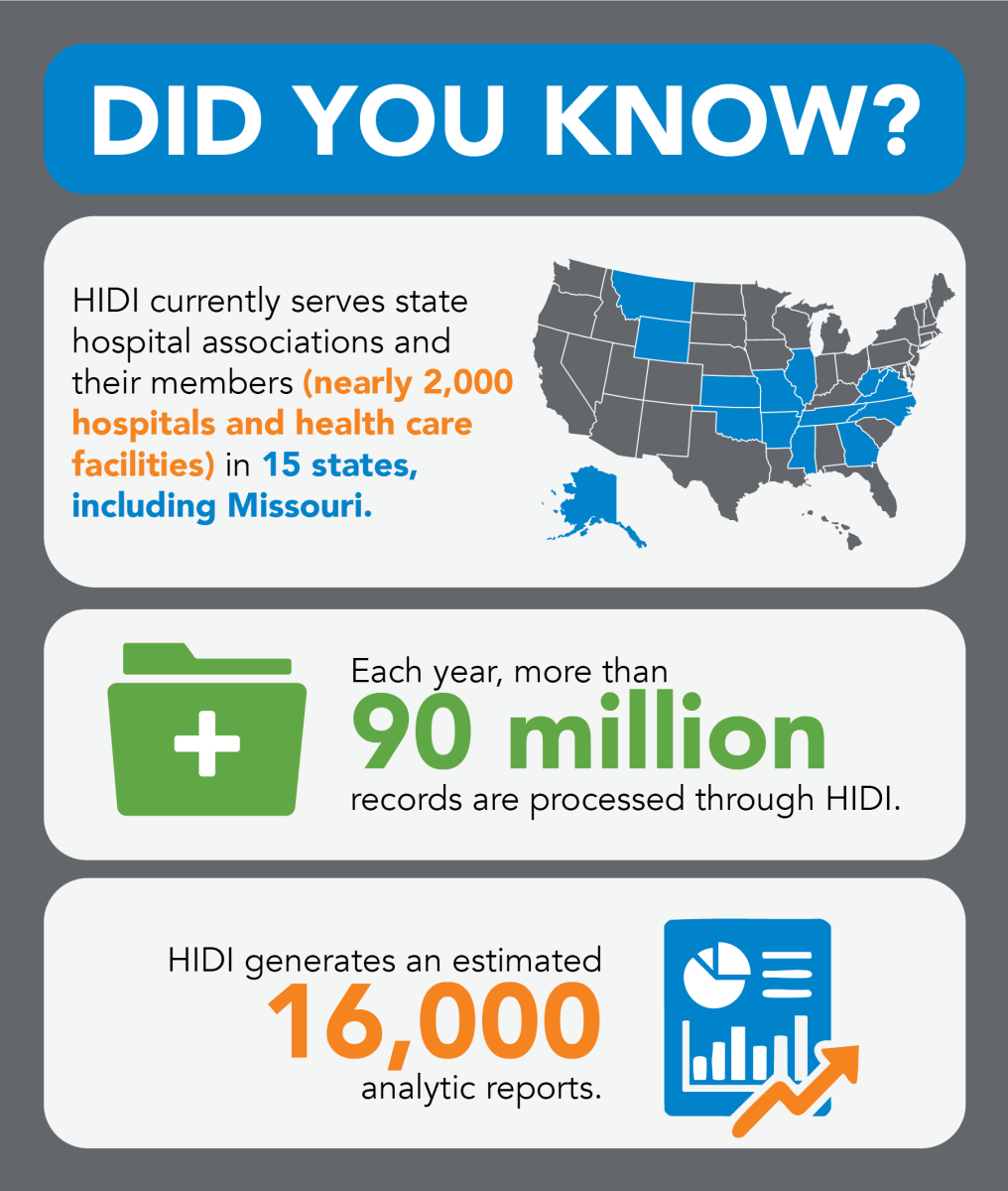
With HIDI, hospitals can see how specific patients are using their services. More importantly, by combining data from hospitals across Missouri, HIDI can provide a fuller, statewide picture for hospitals.
“You can't do that without all the data in Missouri and the trust,” Waterman said.
Looking ahead
From the beginning, trust has been central to the HIDI model. This trust enabled HIDI to grow beyond data collection. Over time, hospitals recognized that with HIDI managing and standardizing their data, they could gain deeper insights, advocate more effectively and improve outcomes.
“I think that trust has built collectively over time, through hospitals seeing us fulfill those [hospital utilization] requirements on an economy of scale that would be much less than if each hospital had to do their own data submission,” Waterman said.
As data and technology constantly change and grow, new forms of information-driven decision-making — as artificial intelligence and health data utilities become more common and various types of regulatory reform occur — will increasingly require more sophisticated collection of data, Waterman said.
“HIDI remains committed to leveraging that data in ways that are rooted in an understanding of our participating hospitals’ needs and the evolving legislation that shapes how data can and should be used,” he said.
Learn more about HIDI’s 40th anniversary and stay up to date with the latest news by following HIDI’s LinkedIn page.
The Missouri Hospital Association is a nonprofit association in Jefferson City that represents 136 Missouri hospitals. In addition to representation and advocacy on behalf of its membership, the association offers continuing education programs on current health care topics and seeks to educate the public about health care issues.